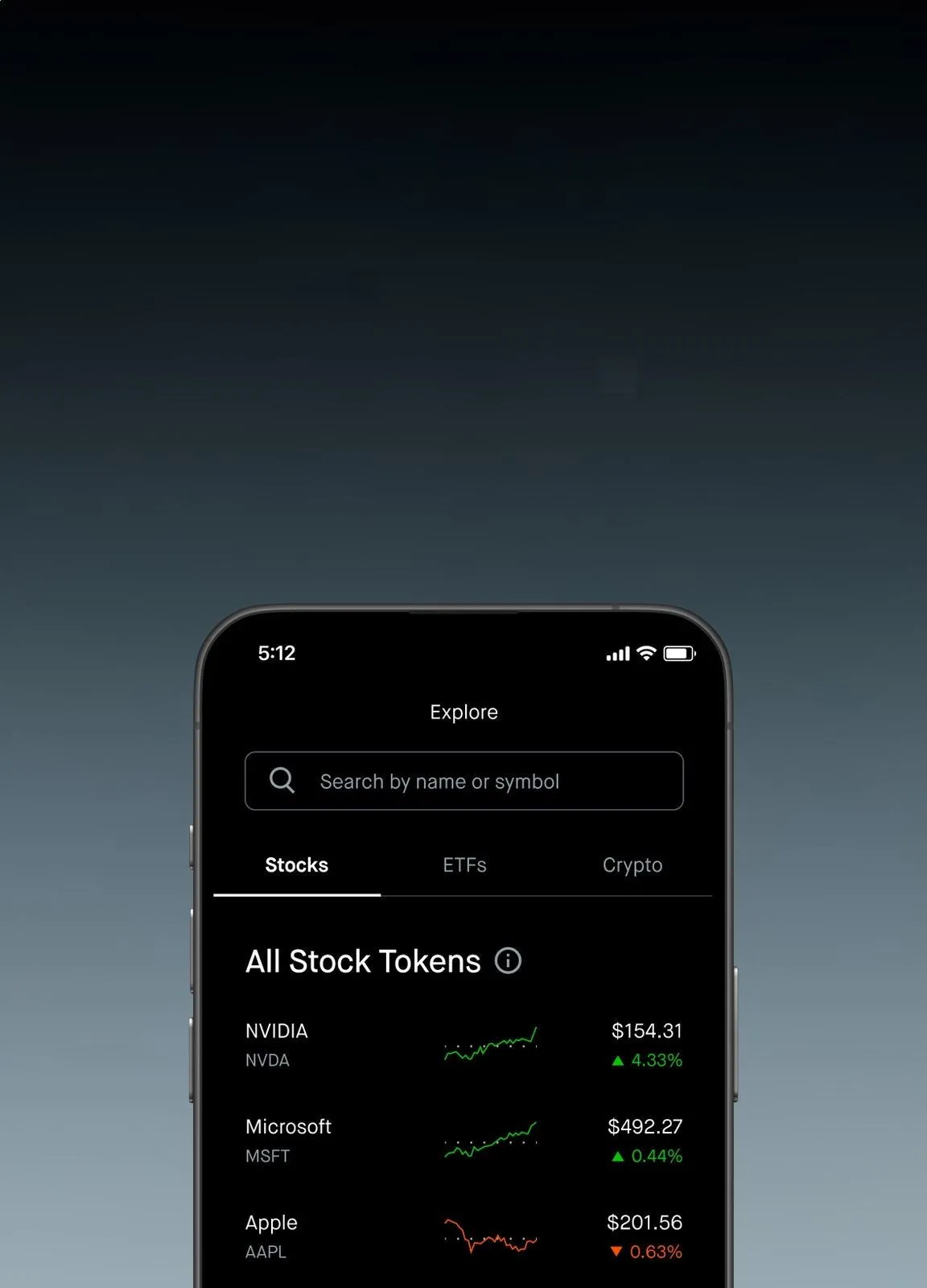
Robinhood fees are route-dependent costs with volume-tier savings
Published: August 2026
Robinhood fees are route-dependent crypto costs: exchange-routed orders pay maker or taker rates from 0.00% to 0.95%, while default market-maker orders charge no commission but execute against a bid-ask spread that contains Robinhood's 0.95% market-maker rebate. On-chain withdrawals add a separate network fee assessed by the selected blockchain. Compare the final crypto quantity or cash credit shown on the review screen, because commission alone does not measure total trading cost.
The cost stack on a Robinhood crypto order
A Robinhood crypto order has three potential cost layers. Trading uses either an explicit exchange-routing fee or spread-based market-maker pricing. A later withdrawal adds a network charge, while optional products follow separate schedules.
Exchange-routing fees apply to the executed dollar value. If $2,000 of notional executes as a market buy in the first tier, the 0.95% taker fee is $19, making the total debit $2,019. A $2,000 sell at that same rate produces a $1,981 credit. This arithmetic separates the fee from any difference between the displayed midpoint and execution price.
Standard pricing lists a $0 Robinhood charge for crypto transfers. It also lists a 25% commission on staking rewards. Robinhood Connect lists 0.0%-1.5% for debit-card or bank-account funding and $0 when Robinhood buying power is used. Those charges belong to different actions; they are not added automatically to a routine crypto trade.
No commission still leaves a quoted spread
Market-maker routing charges no commission, yet its quoted spread remains an execution cost. Robinhood fees under this route sit inside the difference between the chart midpoint and the price at which the order fills, as described in Using Robinhood.
Robinhood Crypto receives $0.95 from its market maker for each $100 of executed notional. The chart displays the mid price. A buy fills at the ask, so its spread is ask minus mid; a sale fills at the bid, so its spread is mid minus bid. A round trip crosses both sides.
Market-maker routing is the standard in-app default and the only route on web classic. The order review shows estimated bid or ask pricing before submission. Robinhood Legend and the mobile ladder use exchange routing instead. A narrow market-maker spread may beat an explicit fee, while a wider quote may cost more despite the zero-commission label.
How the nine exchange-routing tiers reduce rates
The exchange-routing schedule has nine bands based on trailing 30-day executed volume. Higher eligible volume lowers one or both schedule rates at published milestones.
For listed volume of $0-$10,000, the schedule pairs a 0.95% taker rate with a 0.50% maker rate. The next bands are $10,000-$50,000 at 0.75% taker and 0.35% maker, then $50,000-$250,000 at 0.25% and 0.125%.
Rates continue through $250,000-$500,000 at 0.15% taker and 0.075% maker; $500,000-$1 million at 0.125% and 0.06%; $1 million-$5 million at 0.10% and 0.04%; and $5 million-$10 million at 0.04% and 0.02%. The last two bands are $10 million-$25 million at 0.03% and 0.01%, then $25 million or more at 0.03% and 0.00%.
Only completed exchange-routed orders build eligible volume. Market-maker orders, web-classic trades, fees paid, and v1 Robinhood Crypto Trading API orders add nothing to the counter. The volume window rolls across 30 days rather than resetting on a calendar date.
Maker versus taker pricing changes with order behavior
In day-to-day use, Robinhood's maker and taker fees depend on whether an exchange-routed order adds liquidity or executes immediately. Market and stop orders always receive the taker rate. A limit or stop-limit order earns the lower maker rate only when it rests before matching.
Resting conditional orders generally sit on Bitstamp's order book. An immediately executable limit order is a taker order. Robinhood also names EDX Markets as an exchange-routing partner, and it may select an alternate venue when price improvement offsets the higher taker cost. A resting order can remain unfilled when its target appears only elsewhere.
At the first tier, maker pricing is 0.50% versus 0.95% taker, a 0.45-percentage-point gap. At $25 million or more, the maker rate reaches 0.00% while the taker rate remains 0.03%. Robinhood is rolling maker/taker pricing out in stages, so some accounts display a different structure. The rate on the review screen governs that order.
Network fees after crypto leaves Robinhood
More broadly, Robinhood crypto transfers carry a $0 platform fee. The network charge is separate, Robinhood retains 0% of it, and the relevant protocol determines its allocation.
Even so, Robinhood estimates that charge before final submission. For a specified send amount, the estimate is added to the requested quantity. With Send All, it is deducted from the balance, reducing what reaches the destination. Receiving crypto adds no separate Robinhood fee.
Ethereum ERC-20 withdrawals illustrate the mechanism. Supported tokens such as Chainlink (LINK), Compound (COMP), Shiba Inu (SHIB), Uniswap (UNI), and USDC pay an Ethereum network fee in Ether (ETH), but Robinhood converts the estimate and debits the token balance; a separate ETH balance is unnecessary. USDC transfers also support Arbitrum, Base, Optimism, Polygon, and Solana. Network demand, the selected chain, and transaction construction set the live estimate.
The address and selected network must match the receiving service. Once a transfer is broadcast, changing the fee, address, or network is no longer possible.
Comparing Robinhood quotes with Coinbase, Kraken, and Uniswap
A useful quote comparison measures final output for the same side, size, asset, and order behavior. Robinhood, Coinbase Advanced, Kraken Pro, and Uniswap expose different cost structures, so a fee percentage alone is not a common denominator.
Coinbase Advanced and Kraken Pro use order books with published maker/taker schedules. Uniswap is an on-chain automated market maker, where the pool fee, price impact, and blockchain gas all affect output. Robinhood offers a choice between market-maker pricing and exchange routing for eligible in-app assets. Bitstamp and EDX Markets operate behind its exchange route rather than as user-selected destinations.
Use this short decision checklist before choosing a quote:
- Match buy with buy or sell with sell, using identical notional.
- Compare market orders separately from resting limit orders.
- Record final BTC, ETH, or USDC bought, or dollars credited on a sale.
- Add the explicit fee or spread cost shown before submission.
- Include a network estimate only when the assets will be withdrawn.
This comparison keeps custody and transfer plans in scope without charging every trade for a withdrawal that never occurs. It also stops a maker-rate estimate from being compared with a taker execution.
Small orders, API versions, and tier timing
After the first pass, Robinhood fee edge cases cluster around minimum order sizes, API versions, and tier transitions. Market-maker routing accepts orders from $0.01, while exchange routing starts at $0.03.
The Robinhood Crypto Trading API has two versions for this purpose. Executed v2 fee-tier orders count toward eligible 30-day volume, while v1 orders do not. During the staged maker/taker rollout, v2 orders receive the taker rate.
An order does not improve its own price tier. Eligible volume updates after execution, and the reduced rate begins with the next order. An upgrade is protected from downgrade for 7 days, although another upgrade remains possible during that period. Before a sequence of trades, read the displayed tier, routing choice, and final units together; those three fields determine whether the advertised volume saving reaches the account.
Popular questions about Robinhood fees
-
Does Robinhood Gold automatically lower standard crypto trading fees?
- Robinhood Gold does not automatically replace the standard exchange-routing tier schedule. That schedule keys the rate to eligible trailing 30-day volume and maker or taker status. Separate promotions may alter a displayed rate or reimburse a specific network charge for eligible accounts. Treat those promotional terms as distinct from Gold membership itself and read the order preview for the operative fee.
-
How are crypto trading fees treated in Robinhood's average-cost display?
- Robinhood's in-app crypto average cost excludes fees paid on purchases. It is a portfolio reference, while the cash movement, execution confirmation, and tax records use separate calculations. A difference between displayed average cost and total cash outlay therefore does not mean the fee disappeared. Retain the completed order detail when reconciling the position.
-
When does a cancelled or partially filled crypto order create a fee?
- A fully cancelled, unexecuted exchange-routed order has no executed dollar value, so no percentage transaction fee is assessed. If part of the order fills before cancellation, the published rate applies only to that executed portion. The unfilled remainder has no execution charge. Final order details show the actual fee across any completed fills.
-
Why might a long-lived conditional order use an earlier fee tier?
- Robinhood fixes an exchange-routing order's fee tier when the order is placed, not when it later executes. A subsequent tier upgrade therefore does not rewrite the pending order's rate. Cancelling and replacing it creates a new order under the terms then displayed, while also changing that order's placement and execution conditions.
-
Are USDC trades exempt from Robinhood's exchange-routing fees?
- USDC receives no blanket exemption from the standard exchange-routing schedule. An eligible USDC order pays the maker or taker rate attached to the account's volume tier, while market-maker routing uses no commission and fills against its quoted spread. A later USDC withdrawal has a separate network charge on the selected supported blockchain.
-
Can staking rewards raise the 30-day exchange-routing volume?
- Staking rewards do not build the trailing 30-day exchange-routing volume. The counter includes executed exchange-routed crypto orders and excludes separate product activity and fees paid. Robinhood lists a 25% commission on staking rewards in its standard schedule, but that commission belongs to staking rather than the maker/taker trading tiers.